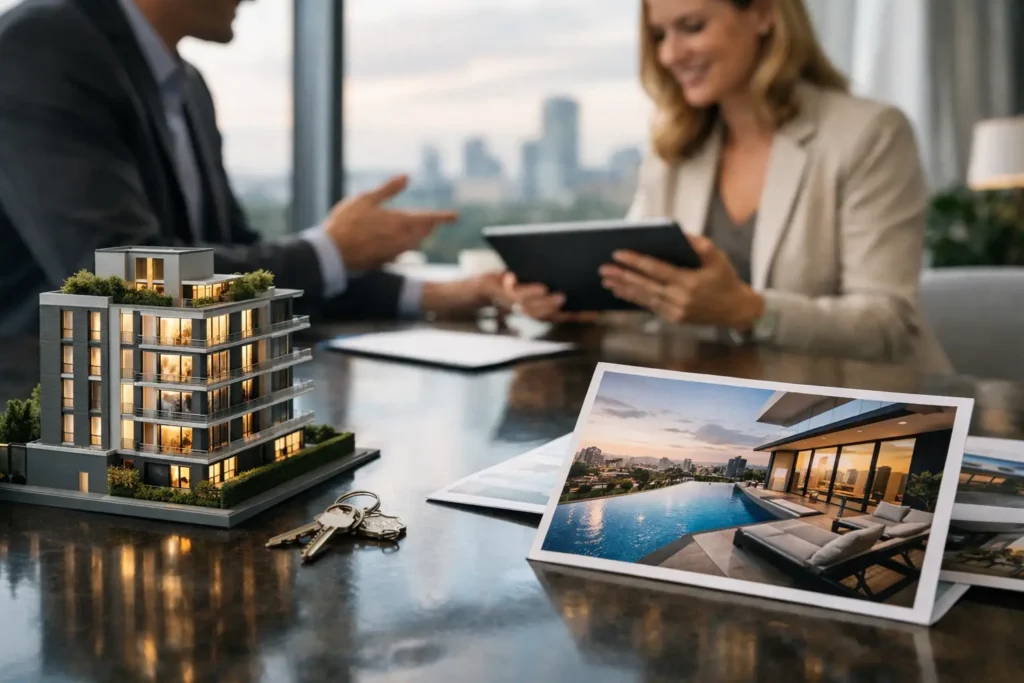
A luxury condo can have panoramic water views, a designer kitchen, and a sought-after South Florida address – then still disappear into a grid of similar listings if the launch assets do not establish why it deserves attention. This luxury condo marketing case study looks at how a strategic visual campaign repositioned a high-end residence from another polished listing into a property buyers could picture themselves owning.
The goal was not simply to generate more clicks. It was to attract qualified interest, help out-of-area buyers understand the residence before they arrived, and give the listing agent the presentation needed to defend the property’s price point from the first day on market.
The Listing: Strong Property, Weak First Impression
The property was a two-bedroom-plus-den luxury condo in a competitive coastal market, positioned for buyers seeking a primary residence, seasonal home, or investment property. It offered floor-to-ceiling glass, a large terrace, upgraded finishes, and access to a full amenity package.
On paper, the listing had every advantage. In practice, it faced a familiar challenge: nearby buildings offered similar square footage, similar views, and similar asking prices. Buyers scrolling the MLS or social media were not comparing features in a spreadsheet. They were responding to the immediate feeling of the space.
The original presentation relied on a small group of interior photos taken at different times of day. The rooms appeared clean but flat. The view was visible, but it did not feel expansive. There was no clear sense of how the living area connected to the terrace, how the den could function, or what arriving at the building felt like.
For a luxury buyer, those gaps create hesitation. If the listing does not answer the practical questions visually, the agent has to spend more time explaining basics to unqualified prospects. More importantly, the property can lose perceived value before a showing is ever scheduled.
The Luxury Condo Marketing Case Study Strategy
The campaign was built around one simple principle: sell the experience of living in the condo, not just the dimensions of its rooms.
That meant creating a coordinated visual stack rather than treating photography, video, drone work, and virtual tours as disconnected add-ons. Each asset had a specific job in moving a buyer from curiosity to confidence.
Start with the buyer’s point of view
The likely buyer was not only purchasing square footage. They were purchasing mornings on the terrace, the convenience of the building, the proximity to the water, and the ability to host without sacrificing privacy.
The shoot plan was organized around those decision points. Wide images established the scale of the main living space. Detail shots captured material quality in the kitchen and baths without becoming decorative filler. Twilight photography showed the residence and city lights at the time of day when the view carried the most emotional weight.
The den received particular attention. In luxury condos, flexible rooms can either add value or create doubt. An empty den can read as an awkward leftover space. With thoughtful staging and clear framing, it was presented as a credible office and guest-ready flex room. The goal was to show the possibilities, not just the space.
Use aerial media to establish location, not just spectacle
Drone capture is most effective when it answers questions that ground-level photography cannot. In this case, aerial footage showed the building’s relationship to the shoreline, nearby dining, marina access, and major routes.
That context mattered because a meaningful share of luxury condo buyers begin their search from another city or state. They may know the neighborhood name, but they still need to understand how the building sits within the market. Aerial footage helped establish that in seconds.
There is a trade-off here. Not every condo needs dramatic drone footage, and not every building allows it. When airspace restrictions, weather, or association rules limit drone capture, elevated neighborhood imagery and carefully chosen exterior coverage can still communicate location. The larger point is to make the setting tangible, not to add flashy footage for its own sake.
Turn the listing into a 24/7 open house
The campaign also included an interactive 3D tour. This was especially valuable for buyers comparing several units in the same price range. Photos can create interest, but a virtual walkthrough helps a serious prospect understand flow, sightlines, ceiling height, and room-to-room relationships.
For the listing agent, that meant fewer conversations spent clarifying the layout and more conversations with people who had already taken time to explore the property. It also gave the agent an asset that worked after office hours, across time zones, and before a buyer committed to travel for an in-person showing.
A virtual tour is not a replacement for a showing in every situation. Some luxury residences depend heavily on atmosphere, materials, or views that are best experienced in person. But it is a strong qualification tool. Buyers arrive with a better understanding of what they are seeing, which makes showings more productive.
The Launch Was Treated Like a Campaign
Premium assets create more value when they are released with intention. Instead of uploading everything at once and hoping the listing gained traction, the launch was structured to create a clear first impression across the channels buyers and agents actually use.
The MLS received a carefully sequenced image set designed to lead with the strongest view and most compelling living spaces. The property website used the full visual story, including video, aerial context, and the 3D experience. Short-form video clips focused on the terrace, the view, and key design details for social media distribution.
The agent also had a package of polished materials ready for broker outreach and direct buyer follow-up. This matters in the luxury segment, where a buyer may be introduced through an advisor, another agent, or a personal referral rather than a standard portal search.
Speed was central to the result. The shoot, editing, and delivery schedule was planned around the listing date so the property did not launch with temporary photos or incomplete media. A fragmented rollout can cost a listing its strongest moment of attention. In a market where new inventory is watched closely, the first 48 hours should look deliberate.
What Changed After the Relaunch
The strongest outcome was not a vanity metric. It was the quality of buyer engagement.
Prospects came into conversations with more specific questions about the residence, the terrace exposure, the building amenities, and move-in timing. They had already seen the layout and understood the home’s relationship to the neighborhood. That reduced the number of low-intent inquiries and helped the agent focus follow-up on buyers with a clearer reason to act.
The visual presentation also changed how the listing was discussed. Instead of competing only on bed count, square footage, and price per square foot, the agent could point to a cohesive lifestyle narrative supported by the media. The property felt considered, current, and aligned with its market position.
That distinction is valuable when buyers are cautious. Luxury buyers may have the budget, but they still want proof that a residence is worth choosing over alternatives. Clear visuals do not manufacture value where it does not exist. They make existing value easier to recognize.
Lessons for South Florida Listing Agents
A luxury condo campaign works best when the media plan reflects the property’s actual strengths and the buyer’s actual decision process. A waterfront unit may need more emphasis on views and orientation. A residence in a design-forward building may benefit from editorial interior photography. A vacant unit may need virtual staging in selected rooms, particularly when buyers struggle to understand scale.
The mistake is treating every premium condo as if it needs the same checklist. High-quality photography is the baseline, but the right mix of video, drone, 3D tours, twilight coverage, and virtual enhancements depends on the listing. The building rules, weather conditions, seller preparation, target buyer, and launch timeline all affect the best approach.
Preparation is equally important. Sellers should know that counters, closets, terraces, and windows will be visible. Lighting needs to work. Personal items should be removed. If the view is a major selling point, schedule the shoot around the light that makes it memorable. These details affect the final product more than most people expect.
For agents competing for luxury listings in Miami-Dade, Broward, or Palm Beach, professional media is not just a marketing expense. It is part of the listing presentation. It shows sellers that their home will not be handled like a standard inventory item, and it gives buyers a reason to stop scrolling long enough to see what makes the residence different.
The next luxury condo you bring to market does not need louder marketing. It needs a sharper visual argument – one that lets the right buyer understand the value before someone else captures their attention.