A trophy office listing can lose momentum before the first showing if the visuals feel flat, dark, or incomplete. That is why agents and property marketers keep asking the same question: what is commercial real estate photography, and how is it different from standard property photos?
Commercial real estate photography is the professional capture of business-focused properties for marketing, leasing, sales, investment packages, and brand presentation. It covers spaces such as office buildings, retail centers, restaurants, industrial sites, mixed-use developments, medical offices, hotels, and multifamily communities. The goal is not just to document a building. It is to position that property as a serious asset, show how the space functions, and help the right buyer, tenant, or investor understand its value quickly.
In South Florida, that difference matters. A commercial property is often competing on location, visibility, tenant appeal, buildout quality, traffic flow, and future use potential. Photos have to do more than make a room look nice. They need to support the pitch.
What is commercial real estate photography used for?
At its core, commercial real estate photography is built for marketing performance. The images are used in MLS and listing platforms when applicable, broker packages, offering memorandums, leasing brochures, email campaigns, social media, paid ads, signage, and property websites. In many cases, the same photo set also supports presentations to landlords, investors, developers, and potential tenants.
That changes how the shoot is planned. A commercial photographer is not only thinking about wide angles and clean edits. They are thinking about what decision-makers need to see. Is there prominent frontage on a major road? Are the common areas recently updated? Does the warehouse have clear loading access? Is the office layout efficient and attractive to a target tenant? Good visuals answer those questions before a call or tour ever happens.
How commercial real estate photography differs from residential
Residential photography usually sells lifestyle at the individual home level. Commercial work is more strategic. It often needs to show utility, income potential, location advantage, and scale.
That means the approach is different from the start. A luxury condo shoot might focus on warmth, flow, and aspirational detail. A commercial shoot may need stronger attention on exterior visibility, parking, signage, floor plate depth, surrounding businesses, loading zones, lobby finish quality, or the relationship between multiple buildings on a site.
The audience is different too. Homebuyers often make emotional decisions first and rational ones second. Commercial buyers, tenants, and investors usually evaluate both at once. They want to know how the property looks, but also how it works.
What a commercial real estate shoot typically includes
The exact scope depends on the property type, but most commercial real estate photography includes interior images, exterior images, and location-focused visuals. Exterior coverage usually captures curb appeal, architecture, access points, parking, signage, and the building’s presence from different angles. Interior coverage shows layout, finishes, natural light, ceiling height, amenities, and how the space supports business use.
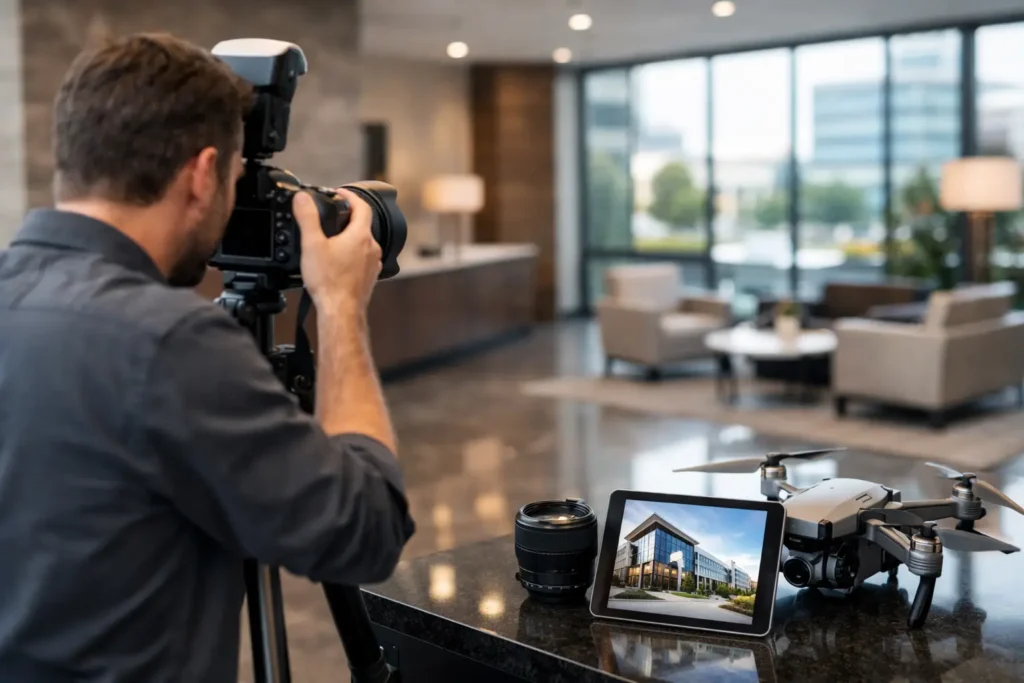
For some properties, standard still photography is enough. For others, the listing needs a fuller media package. Drone photos can show traffic corridors, nearby retail, water access, adjacency to major roads, or the scale of a development in a way ground photography cannot. A 3D tour can help remote tenants or investors understand layout before scheduling an in-person visit. Video becomes useful when the property has movement, lifestyle appeal, or multiple selling points that need a stronger narrative.
This is where many agents gain an edge. Instead of treating photography as a box to check, they build a visual package that reduces friction. Better visuals mean fewer wasted inquiries and more informed showings.
What makes commercial real estate photography effective
Strong commercial imagery is not about making every frame look dramatic. It is about making each frame useful and persuasive.
Composition matters because commercial spaces need to read clearly. Vertical lines should stay straight. Wide shots should feel spacious without looking distorted. Lighting should reveal finishes and depth without making the space look artificial. The editing should be polished, but still credible. If a medical office or retail unit looks overly processed, buyers notice.
Timing matters too. Exterior shots may need to be captured when the building has the best natural light, when shadows are controlled, or when the property feels active but not cluttered. In South Florida, weather can also change the result fast. Harsh midday sun, reflective glass, and fast-moving cloud cover all affect how a commercial site photographs.
Preparation is just as important as camera work. Vacant space may need basic staging or at least cleaning and decluttering. Occupied offices may need coordination around staff, patients, shoppers, or business operations. Restaurants and hospitality spaces often benefit from carefully planned timing so the location looks polished without appearing empty.
Why it matters for leasing and sales
Commercial listings do not always get many chances to make a first impression. A broker package lands in an inbox, a listing appears in search, or a prospect scrolls past it on a phone. If the visuals fail there, the property may never get a second look.
Professional photography helps create stronger perceived value. It shows that the asset is being marketed seriously, which can influence how buyers and tenants interpret everything else in the listing. Better images can also improve click-through rates, increase time spent reviewing the property, and lead to more qualified inquiries.
That does not mean photos alone close deals. Price, location, lease terms, tenant mix, and market conditions still drive outcomes. But poor visuals can drag down interest even when the fundamentals are strong. Good visuals help the property compete on its actual merits instead of getting overlooked because the marketing feels weak.
What is commercial real estate photography for different property types?
Office
Office photography should show professionalism, layout flexibility, common areas, conference rooms, reception, natural light, and building quality. For suburban office or Class A space, the surrounding business environment can matter almost as much as the suite itself.
Retail
Retail images need to highlight frontage, signage, visibility, pedestrian access, parking, neighboring tenants, and traffic patterns. A beautiful interior matters less if the property does not clearly show exposure and access.
Industrial
Industrial photography focuses on function. Clear spans, loading docks, warehouse depth, ceiling height, truck access, yard space, and circulation matter more than decorative detail. Accuracy is everything.
Hospitality and multifamily
These properties need a blend of operational and lifestyle storytelling. The visuals should show amenities, shared spaces, design quality, and guest or resident appeal while still presenting the asset as an investment-grade property.
When to invest in more than still photos
It depends on the listing strategy. If you are marketing a smaller office condo or a straightforward retail suite, high-quality photography may be enough. If you are promoting a large shopping center, mixed-use project, hotel, or waterfront commercial asset, stills alone can leave too much on the table.
Drone capture becomes especially valuable when location context helps sell the deal. Aerials can show highway access, nearby anchors, walkability, surrounding development, and the true footprint of a site. Virtual tours help when decision-makers are out of market or when the property has a layout that still images cannot explain clearly. Video adds impact when you want the listing to feel more premium and more memorable across digital channels.
The right mix depends on budget, timeline, and how competitive the listing is. Not every property needs the full stack. The smart move is matching the media package to the size of the opportunity.
Choosing the right photographer for commercial work
If you are hiring for commercial property, look beyond whether the images are attractive. Ask whether the photographer understands marketing intent. Can they capture a building in a way that supports leasing? Do they know how to show traffic exposure, property access, and functional layout? Can they work efficiently on active sites without disrupting operations?
Speed matters. So does consistency. In a market like Miami-Dade, Broward, and Palm Beach, listings move fast, and presentation affects how quickly you can get in front of serious prospects. A dependable media partner should deliver polished work on schedule and understand that the photos are part of a larger sales process, not an isolated creative exercise.
That is why experienced teams often outperform general photographers. They know how to create assets that help brokers win attention, justify value, and move prospects closer to a showing.
Commercial real estate photography is not just about making a building look better. It is about making the opportunity easier to understand and harder to ignore. If your listing needs to compete for serious attention, the visuals should work as hard as the pitch.