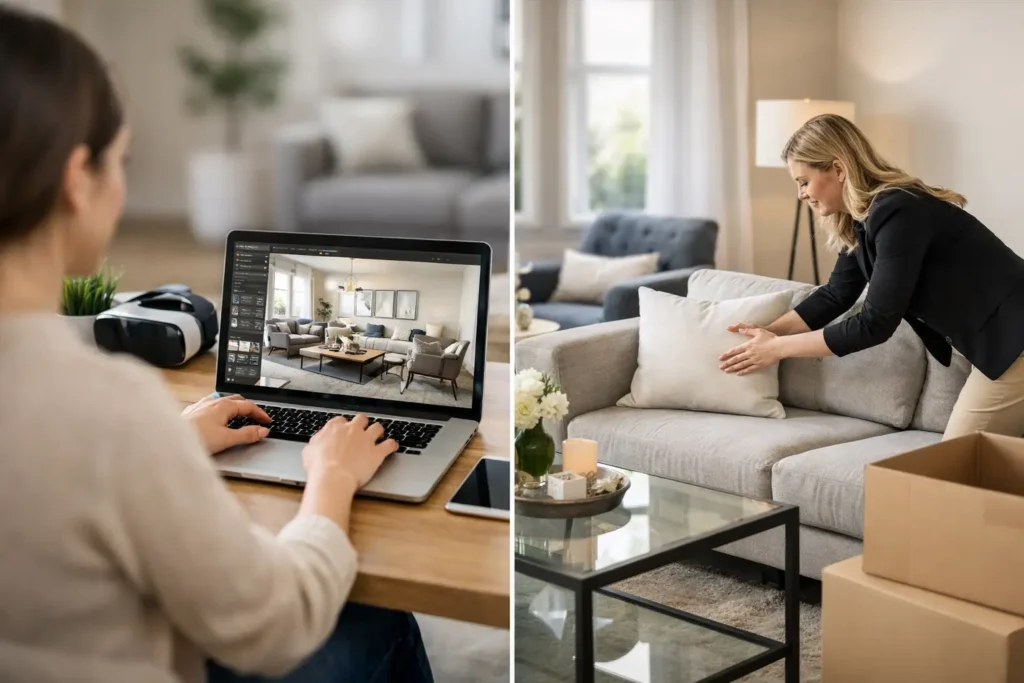
A vacant condo in Brickell can look clean in person and still fall flat online. That gap is where the real debate around virtual staging vs traditional staging starts. If buyers scroll past the listing before they ever book a showing, the question is not which option looks nicer in theory. It is which one helps your property compete faster, present better, and generate stronger buyer interest.
For agents in South Florida, that decision usually comes down to timeline, price point, property condition, and how the home will be marketed. A luxury waterfront listing in Miami Beach and a vacant investment condo in Fort Lauderdale do not need the same staging strategy. The strongest choice is the one that fits the listing, the audience, and the speed of the market.
Virtual staging vs traditional staging: what changes in the buyer experience?
Traditional staging changes the physical property. Furniture, decor, and layout choices are installed in the home so that every in-person visitor walks into a finished environment. The buyer does not have to imagine how a living room might function or whether a bedroom can fit a king bed. They see it immediately.
Virtual staging changes the marketing assets, not the property itself. A designer adds realistic digital furniture and decor to listing photos so vacant or outdated rooms appear finished online. The actual space remains empty or unchanged when a buyer arrives.
That difference matters because most buyers meet the property online first. On MLS, social media, and listing websites, virtual staging can do a lot of the heavy lifting. It gives empty rooms context, improves perceived livability, and helps people understand scale. For many listings, that alone can be enough to win the click, earn the showing, and move the process forward.
But once buyers walk in, the illusion ends. If the property is physically vacant, the in-person experience has to stand on its own. That is why virtual staging works best when the photos are strong, the layout is clear, and expectations are managed properly.
When virtual staging makes more sense
Virtual staging is usually the faster and more cost-effective option. For agents managing vacant listings, short timelines, or tighter marketing budgets, that advantage is hard to ignore. You can turn an empty room into a polished, lifestyle-driven image without coordinating furniture delivery, installation, rental periods, or removal.
That speed matters in South Florida, where inventory presentation can affect momentum in the first few days on market. If you need to launch quickly, virtual staging lets you create a more compelling visual package without delaying photography or listing activation.
It is especially useful for vacant condos, new construction, investor-owned properties, and homes where the existing furniture is doing the listing no favors. It can also help define awkward spaces. A spare room becomes a home office. A large corner in an open floor plan becomes a dining area that feels intentional instead of empty.
For digital-first marketing, virtual staging is often the better fit. If your main goal is to improve online engagement, stop the scroll, and show possibilities in a clean, controlled way, the return can be strong. Serious agents use it to create sharper first impressions and reduce the mental work buyers have to do.
The catch is realism. Bad virtual staging hurts credibility fast. Oversized furniture, inconsistent lighting, and overly stylized decor make the listing feel artificial. Buyers notice. The solution is not avoiding virtual staging. It is using it well, with accurate scale, market-appropriate design, and images that still respect the actual architecture and condition of the home.
When traditional staging earns its cost
Traditional staging is more expensive, more labor-intensive, and slower to coordinate. Even so, there are listings where it clearly does the heavier lifting.
If the property will rely on in-person emotional impact, physical staging can be worth every dollar. Luxury homes are the clearest example. When buyers tour a high-end property in Coral Gables, Boca Raton, or along the Intracoastal, they are not just assessing square footage. They are responding to atmosphere, flow, and lifestyle. Physical staging helps create that response in a way digital images cannot fully replicate.
Occupied homes can also benefit from partial or full traditional staging when existing furnishings are outdated, oversized, or distracting. A well-staged home photographs better, shows better, and often feels more move-in ready. That can increase perceived value, especially when buyers are comparing similar homes in the same neighborhood.
Traditional staging also reduces friction during showings. There is no disconnect between the listing photos and the actual experience. Buyers see the same polished presentation online and in person. For properties where showings are frequent and buyer expectations are high, that consistency can strengthen trust.
Still, it does not automatically make sense for every listing. If the home needs repairs, if the timeline is compressed, or if the expected sale price will not support the cost, physical staging may not be the smartest play. The best marketing decision is not always the most elaborate one. It is the one that improves performance without eroding your margin or delaying launch.
Cost, speed, and flexibility
This is usually where the decision gets practical.
Virtual staging wins on speed. Once the property is photographed, staged images can typically be produced far faster than a traditional staging install can be planned and executed. That gives agents a major advantage when timing matters.
It also wins on flexibility. You can test different room uses, vary design styles based on the target buyer, and stage only the key images that matter most. That level of control is useful when you are tailoring marketing to different segments, such as first-time condo buyers, seasonal residents, or luxury relocation clients.
Traditional staging wins on physical impact, but it comes with more moving parts. Scheduling, rental fees, installation, revisions, and removal all add complexity. For some listings, that complexity is justified. For others, it becomes drag.
A practical way to think about it is this: if the listing lives or dies on online presentation, virtual staging often delivers the better value. If the listing needs to convert at the front door as much as it does on the screen, traditional staging deserves a closer look.
What South Florida agents should weigh before choosing
Market context matters. South Florida is visually competitive, and buyers are used to polished media. That means empty rooms are at a disadvantage, especially in condo-heavy markets where layout and usability need to be communicated quickly.
But not every buyer pool responds the same way. Investors and value-driven buyers may care more about clean visuals and floor plan logic than a fully staged in-person experience. Luxury buyers, international buyers, and lifestyle-driven owner-occupants may expect a stronger physical presentation.
You should also consider the property itself. A modern vacant condo with great light can perform extremely well with high-end virtual staging and strong photography. A large single-family luxury home with multiple entertaining spaces may need physical staging to fully communicate scale and use.
Then there is disclosure and expectation management. If you use virtual staging, be clear that the images are digitally enhanced. That protects trust and keeps the showing experience honest. The goal is to help buyers visualize potential, not misrepresent the property.
For many agents, the smartest answer is not choosing one side forever. It is building a listing-by-listing strategy. Some homes need full traditional staging. Some need only virtual staging. Some need a hybrid approach, where a few principal rooms are physically staged and secondary spaces are enhanced digitally for marketing.
That is the advantage of working with a media partner that understands how presentation affects listing performance, not just how to make photos look attractive. In a market where speed, perception, and competition all matter, the right visual strategy is part of the sales strategy.
If you are deciding between virtual staging and traditional staging, start with the outcome you need. Do you need faster launch, lower cost, and stronger online engagement? Or do you need a physical experience that justifies price, supports showings, and elevates the listing in person? The right choice is the one that helps buyers see the value faster and helps your listing move with fewer missed opportunities.