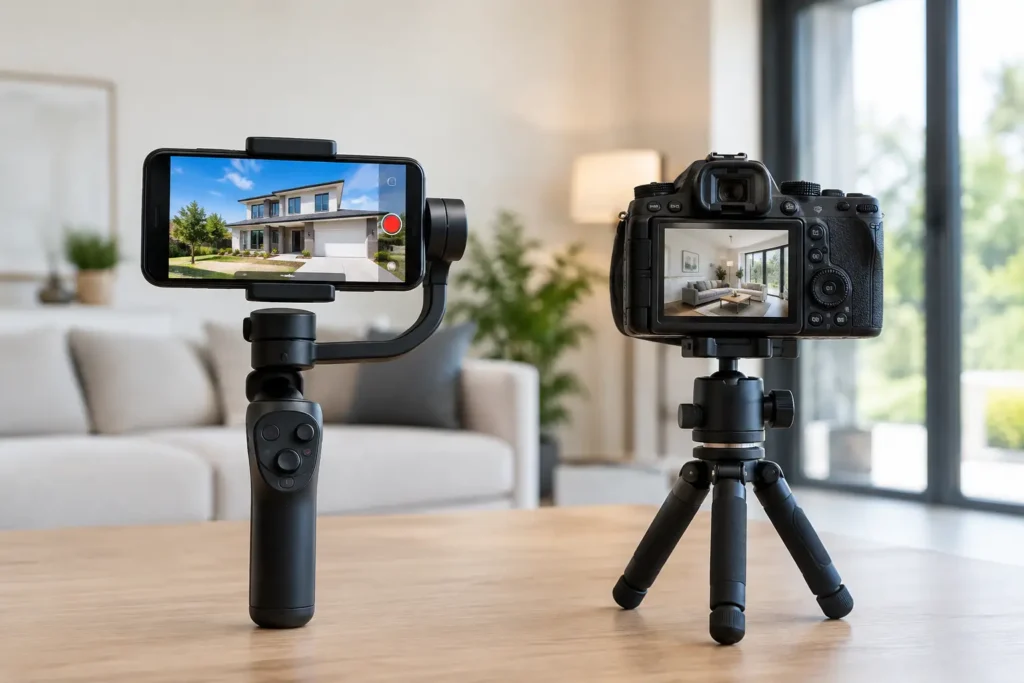
A buyer scrolling Instagram may give your listing two seconds before moving on. A serious buyer deciding whether to book a showing needs more than two seconds – they need to understand the home. That is the real distinction in property reels versus listing videos: one earns attention quickly, while the other builds enough confidence to move a buyer closer to action.
Agents often treat these formats as interchangeable because both involve video. They are not. A reel and a listing walkthrough should be planned, filmed, edited, and distributed for different buyer behaviors. When each asset has a clear job, your listing marketing works harder across social media, MLS, property websites, email, and agent-to-agent sharing.
Property Reels Versus Listing Videos: Different Jobs
A property reel is short-form, vertical, and built for interruption. It is made for a buyer, neighbor, or potential seller who was not actively searching for that specific home when it appeared on their screen. Its purpose is to stop the scroll and create a reason to learn more.
A listing video is a longer, more complete presentation of the property. It gives interested buyers context: how the spaces connect, where the light comes from, what the outdoor area feels like, and which features justify a closer look. Its purpose is not simply to impress. It is to qualify interest and reduce uncertainty before a showing.
That difference matters in South Florida, where buyers may be comparing waterfront condos, single-family homes, and investment properties from out of town. A fast reel can make someone notice a view or a dramatic pool deck. A well-built walkthrough helps that same person understand the flow from the entry to the living space, the relationship between the primary suite and outdoor areas, and the overall scale of the home.
The strongest campaigns do not choose one format over the other. They use a reel to create demand and a listing video to give that demand somewhere useful to go.
What a Property Reel Should Do
A reel is not a shortened version of every room in the house. Trying to cram an entire property tour into 20 or 30 seconds usually produces a fast, forgettable sequence of clips. The viewer sees a kitchen, a bathroom, a bedroom, and moves on without retaining why this particular home matters.
A better reel starts with the strongest visual or lifestyle hook. For a Miami Beach condo, that could be the first view through the glass toward the water. For a Coral Gables home, it may be a dramatic arrival, a mature backyard, or an indoor-outdoor living area. For an investment property, the hook may be location, updated finishes, or a feature that creates immediate rental appeal.
The reel should then support one clear message. This is the home with the sunset terrace. This is the renovated residence with a private dock. This is the family home where the kitchen, pool, and covered patio actually work together. Short on-screen text can reinforce the point, but the visuals must carry the momentum.
Vertical framing is essential because reels are designed for phones. That does not mean every clip must be shot vertically from the start. It means the production plan needs to account for vertical crops, safe text areas, and the way a property reads in a narrow frame. Wide rooms, long sightlines, and aerial footage require careful composition so the most valuable detail is not lost.
A reel can also support your own business development. Sellers pay attention to how agents market homes. Consistent, polished short-form video signals that you know how to position a listing where buyers spend time. But the goal should remain commercial, not performative. A reel that gets views but fails to create inquiries, saves, shares, or property page visits is not doing enough.
What a Listing Video Should Do
A listing video gives the buyer a guided experience of the property. It should answer the questions that still images cannot answer alone: What is the arrival like? Does the main living area feel open or segmented? Is the kitchen connected to the entertaining space? How usable is the balcony, yard, rooftop, or pool area?
This is where cinematic walkthrough footage earns its place. Controlled camera movement can show transitions between spaces instead of presenting each room as an isolated image. Aerial video can establish proximity to the beach, bay, marina, golf course, or neighborhood amenities when that location context supports the property’s value proposition.
The best listing videos are selective. They do not need to document every closet or repeat every secondary bedroom at the same length. They should give the most time to the areas that influence a purchase decision. In a luxury condo, that may be the view, terrace, primary suite, and building amenities. In a family home, it may be the kitchen, main gathering spaces, bedroom layout, and backyard.
Length depends on the property and audience. A compact condo can often be presented effectively in a concise walkthrough. A larger estate may need more time to establish the grounds, architectural details, and distinct living zones. The test is simple: every scene should either clarify the property, increase desire, or provide useful location context. If it does none of those, it is filler.
A full listing video is especially valuable for relocation and second-home buyers. These buyers may not be able to tour immediately, and they need enough visual information to decide whether the property belongs on their shortlist. Combined with HDR photography, a 360-degree virtual tour, and an accurate floor plan, video turns the listing into a more complete digital showing.
Use the Format That Matches the Marketing Stage
The right question is not, “Should I order reels or video?” It is, “What does this listing need next?”
At launch, a reel can create an initial burst of attention on Instagram, Facebook, and other social channels. It gives agents a shareable asset that is easy to send to their sphere, use in Stories, or include in targeted campaigns. A longer listing video can then live on the property website, be shared directly with active prospects, and help buyers spend more meaningful time with the listing.
For a price improvement, a fresh reel can spotlight a feature that was overlooked in the first marketing push. Do not simply repost the same footage with a new caption. Reframe the story. Lead with the water view, the redesigned kitchen, the walkability, or the outdoor entertaining space that makes the property more compelling at its current position.
For a property with an unusual layout, a listing video and floor plan are often more important than a reel. Buyers need clarity before they need hype. If the home includes separate guest quarters, multiple levels, a detached office, or a nontraditional indoor-outdoor configuration, show how it works. Better-informed buyers tend to arrive at showings with more realistic expectations.
Production Choices That Affect Results
The format only works when the underlying footage is strong. Poor lighting, rushed camera movement, distorted vertical lines, and random room sequencing can make even a well-located property feel less valuable. Video should be planned after the property has been evaluated, not treated as an add-on captured in a few minutes.
Start with the buyer story. Identify the first impression, the signature feature, and the practical details that a buyer needs to understand. Then build the route through the property around that sequence. In some homes, the right opening is the front elevation and arrival. In others, it is immediately showing the view because that is the reason the buyer clicked.
Audio also requires a decision. Music can set pacing and mood, particularly for social reels. A narrated approach can work when the home has details that need explanation, such as smart-home systems, architectural provenance, or a significant renovation. Neither is automatically better. The choice should support the property and the channel where the video will be used.
Captions and concise text overlays help because many viewers watch social content without sound. Keep them factual and specific. “Bay views from every main living area” says more than “Luxury at its finest.” Avoid claims that the footage cannot prove or language that makes every listing sound identical.
Build One Video Shoot Into a Complete Asset Set
Efficient listing marketing comes from planning a coordinated visual stack. During the same production window, professional photography can handle MLS essentials, aerial capture can establish location, walkthrough footage can support the longer listing video, and vertical clips can be selected for reels. The assets should feel consistent because they are all telling the same property story.
That consistency matters when a buyer moves from a reel to your listing page, then to the photo gallery, floor plan, and virtual tour. If each piece highlights a different version of the home, the campaign feels fragmented. If they reinforce the same strengths, buyers gain confidence faster.
Digitall Media approaches this as a sales presentation, not just a collection of attractive shots. The objective is to show the possibilities, clarify the property, and give agents usable content for every point in the buyer journey.
A reel earns the next click. A listing video helps earn the next showing. Plan both around the questions your best buyer will ask, and your marketing will do more than look good on launch day.