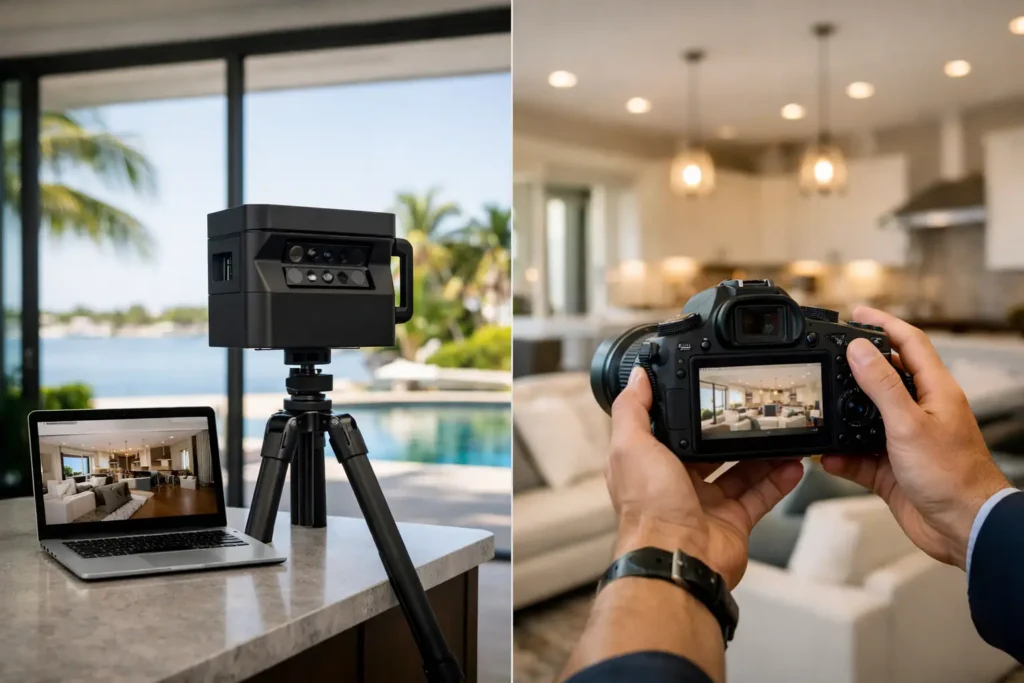
A buyer is scrolling listings from New York, Chicago, or overseas and sees two South Florida homes with similar price points. One has a polished video. The other lets them move from the waterfront living room to the primary suite at their own pace. The 3d tours vs video decision affects what that buyer understands before they ever request a showing – and whether your listing feels more credible than the next one.
For agents competing in Miami-Dade, Broward, and Palm Beach, this is not a question of choosing the newest visual tool. It is about matching the asset to the property, the buyer, and the way the home will be marketed. Video creates emotion and momentum. A 3D tour creates confidence in the layout. The strongest listing strategies often need both, but not every property needs the same production mix.
3D Tours vs Video: The Core Difference
A listing video is a guided experience. The viewer sees the property through a deliberate sequence of shots, music, pacing, and detail. It can lead with an aerial view of the Intracoastal, move through a dramatic double-height entry, then finish on a pool deck at sunset. That control is its advantage. Video shows buyers what to feel about the home.
A 3D tour is an interactive experience. Buyers choose where to go, how long to stay, and which areas deserve a closer look. They can walk from the kitchen to the family room, check how the bedrooms relate to one another, or revisit the balcony from a different angle. It helps them answer a more practical question: does this home work for the way I live?
That distinction matters because real estate decisions are both emotional and logistical. A buyer may be drawn in by the lifestyle a video presents, then use a 3D tour to validate the floor plan, room flow, and sense of scale.
When Video Has the Stronger Selling Role
Video is the better tool when a property’s value lives in its atmosphere, setting, and story. This is especially true for luxury homes, waterfront properties, new developments, and listings where outdoor spaces carry major appeal. A well-produced film can show the approach to the home, light moving across a great room, boats on the water, or the transition from indoor entertaining space to a resort-style backyard.
It also performs exceptionally well where attention is limited. Social media viewers are not usually looking to inspect a floor plan. They are looking for a reason to stop scrolling. Short-form video, vertical reels, agent-led walkthroughs, and cinematic property films give you assets that can build awareness well beyond the MLS.
Video gives the agent room to sell more than square footage. You can frame a Miami condo around walkability and skyline views, a Boca Raton estate around family entertaining, or a Fort Lauderdale waterfront home around the boating lifestyle. That context can raise perceived value because it connects features to a buyer’s aspirations.
The trade-off is that video is passive. Even an excellent walkthrough may leave buyers wondering what sits behind the camera or how one room connects to the next. A filmmaker can make a space feel expansive, but the buyer still needs to trust the layout. For serious out-of-market prospects, that missing layer can lead to more questions before a showing is booked.
Video is especially effective for
Video is often the best first investment for a visually dramatic listing, a home with premium exterior amenities, or a campaign built around social media reach. It is also a strong choice when the agent needs personal brand content, because an on-camera introduction can build familiarity and credibility with future sellers as well as current buyers.
Where 3D Tours Earn Their Place
A Matterport-style 3D tour gives buyers something a video cannot: control. They can explore on their schedule, return as often as needed, and inspect the property without waiting for an agent to open the door. For a buyer comparing several homes from another state or country, that convenience can be the difference between casual interest and a serious inquiry.
This format is particularly useful when layout is a major selling point. Think of a large single-family home with separate wings, a multi-level townhouse, a condo with an unusual floor plan, or a home where the kitchen, bedrooms, and outdoor areas need to be understood in relation to one another. A 3D tour makes the spatial story easier to grasp.
It can also improve showing quality. Buyers who have already toured a property virtually arrive with a clearer understanding of what they are about to see. That does not eliminate unqualified traffic, but it can reduce appointments from people who would immediately reject the layout, room configuration, or overall scale in person.
For occupied homes, a 3D tour can keep the listing accessible between showing windows. For vacant homes, it turns an empty space into a 24/7 open house that supports the listing long after the initial launch. Agents can send it directly to interested prospects and use it as a practical follow-up tool after an inquiry.
The limitations to plan around
A 3D tour is not designed to create the same emotional lift as a cinematic video. It may accurately show a room, yet fail to capture the feeling of ocean views at golden hour or the energy of an outdoor kitchen during an evening gathering. It also requires careful preparation. Clutter, closed doors, poor lighting, and unfinished details are more noticeable when buyers can inspect every direction.
That means a tour should never be treated as an excuse to skip professional photography, staging, or property readiness. Accuracy is valuable, but accuracy must still be presented at the highest standard.
Which Format Fits Your Listing?
The right choice depends on what is most likely to move a buyer from curiosity to action. Start with the property’s clearest advantage.
If the home wins on architecture, views, landscaping, water access, or a lifestyle buyers need to imagine, lead with video. A short, intentional film can make the listing memorable and create the kind of emotional response that earns clicks, shares, and showing requests.
If the home wins on size, efficient layout, multiple levels, flexible rooms, or long-distance buyer appeal, a 3D tour may have more direct value. It lets prospects investigate the details that determine whether the property belongs on their shortlist.
Price point matters, but it should not be the only factor. A modestly priced home with a complicated layout may benefit more from a 3D tour than a straightforward luxury condo. Likewise, a high-end waterfront listing deserves video because its value is not limited to its rooms. It is selling a setting that static images and an interactive walkthrough may not fully communicate.
The Best Answer Is Often Both
For listings where the budget supports a full visual campaign, video and 3D tours do different jobs rather than competing for the same job. Video attracts. The 3D tour qualifies. Professional photography supports search results and MLS browsing. Drone capture establishes location and lot context. Together, these assets give buyers multiple ways to engage based on where they are in the decision process.
A strong launch sequence may use a cinematic teaser or vertical reel to generate initial attention, photography to make the MLS gallery perform, and a 3D tour for buyers who want to explore deeper. Then, during follow-up, the agent can send the tour to a relocating buyer, share the video with a prospect who responds to lifestyle, or use both in a listing presentation to show sellers how the home will be positioned.
This combined approach is most valuable in South Florida’s competitive market, where buyers often make quick first judgments online but still need enough information to act with confidence. It gives your listing more than one chance to make the case.
Production Details That Affect Results
The format is only part of the equation. A rushed video with shaky camera movement and no clear story will not elevate a listing. A poorly prepared 3D tour can make a home feel smaller, darker, or more cluttered than it is. The quality of capture, editing, lighting, and property preparation determines whether the asset strengthens perceived value or works against it.
Before scheduling either service, prepare the home as if every room will be examined closely. Clear counters, open blinds when privacy allows, replace burned-out bulbs, remove pet items, and make sure pools, patios, and outdoor spaces are presentation-ready. For video, consider the best time of day for views and exterior light. For a 3D tour, make sure every room buyers should access is unlocked and ready to be seen.
The practical question is not whether 3D tours or video is better in every case. It is which format removes the biggest obstacle between your ideal buyer and a showing. When the property needs to be felt, use video to tell its story. When it needs to be understood, use a 3D tour to let buyers explore. When the listing deserves maximum exposure and serious buyer confidence, give them both reasons to stay longer.