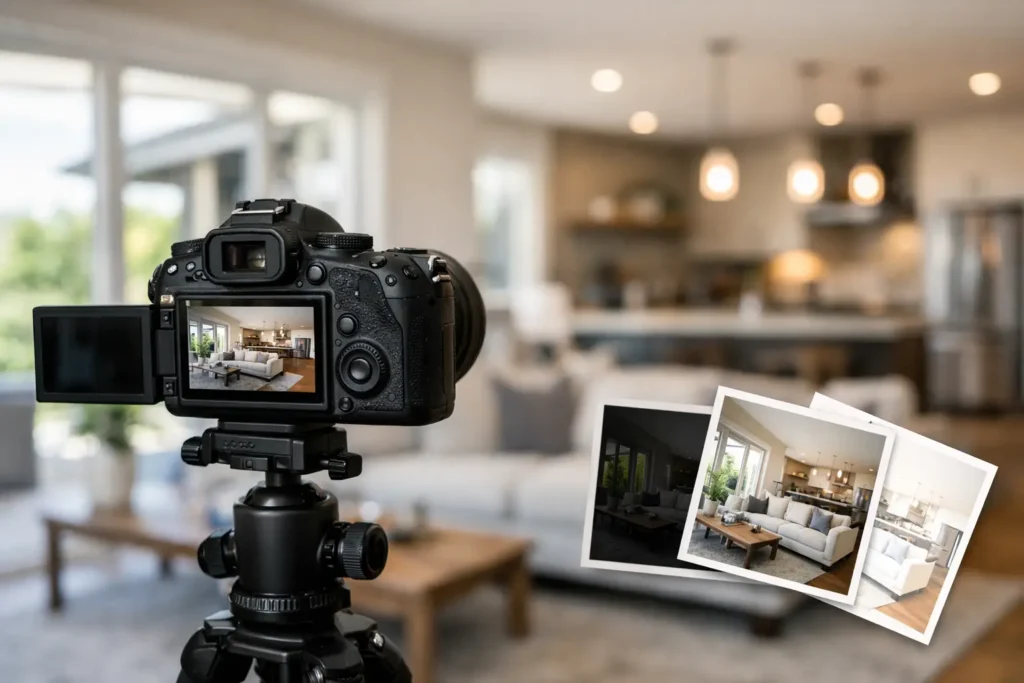
A bright Miami waterfront condo can look perfect in person and completely wrong in a single photo. The view blows out to pure white, the living room turns muddy, and the listing loses the one thing buyers actually respond to – clarity. That is exactly where the question comes up: what is bracketing in real estate photography? It is one of the most effective techniques for capturing a property the way buyers need to see it, especially when a room has both strong sunlight and darker interior details.
Bracketing means taking multiple photos of the same composition at different exposure levels. One frame may be exposed for the windows, another for the midtones, and another for the darker parts of the room. Those images are then blended in editing to create one final photo that holds detail across the full scene.
For real estate, that matters because homes rarely have even lighting. South Florida properties are a perfect example. Large windows, bright exteriors, reflective surfaces, and open layouts create beautiful spaces for showings, but they are difficult to capture in a single exposure. If you expose for the room, the exterior gets washed out. If you expose for the exterior, the room feels underlit and uninviting. Bracketing solves that gap.
What is bracketing in real estate photography, exactly?
In practical terms, a photographer places the camera on a tripod and takes a sequence of images without changing the composition. The only thing that changes is the exposure. A common bracket might be three to five frames, though some scenes require more.
The goal is not to create a fake-looking image. The goal is to produce a balanced, accurate photo that shows what the space actually offers. Buyers want to see the kitchen finishes, the natural light, and the pool view all at once. A bracketed image gives you a much better chance of showing those selling points in one polished final frame.
This is different from simply brightening a dark image in editing. Once highlights are blown out or shadows are too noisy, there is only so much software can recover. Bracketing captures that information at the time of the shoot, which gives the editor far more control and typically leads to cleaner results.
Why bracketed photos perform better for listings
Real estate photography is not just about making a room look nice. It is about helping a buyer understand the home quickly and helping an agent present the listing at a higher perceived value. Bracketing supports both.
When your photos show window detail, interior finishes, and true room brightness in the same image, the listing feels more premium. It reads as well-produced and trustworthy. That matters on MLS, on social media, and on property websites where buyers are deciding in seconds whether to click, save, or move on.
There is also a practical advantage. Better photos tend to filter out confusion. If a room is too dark, too yellow, or too blown out, buyers may misread the space before they ever book a showing. Bracketing helps present a property more clearly, which can reduce wasted attention and attract better-qualified interest.
For agents competing in fast markets like Miami-Dade, Broward, and Palm Beach, that visual edge is not minor. It can affect how quickly a listing gets traction and how professionally the property is perceived from day one.
How bracketing works during a shoot
The process itself is straightforward, but doing it well takes control and consistency. The photographer first composes the room, usually on a tripod to keep every frame aligned. Then the camera captures a sequence of exposures, often through auto exposure bracketing.
For example, one image might be underexposed to preserve the bright outdoor view. Another might be neutral for the overall room. A third might be brighter to reveal shadow detail in cabinetry, furniture, or architectural features. In more difficult conditions, such as a room with direct sun and shaded corners, additional exposures may be added.
After the shoot, those images are blended manually or with software. The editor combines the best parts of each frame to build a final image with more balanced highlights, shadows, and color. Done properly, the result should look natural, not overprocessed.
That last part matters. Bracketing is a technique, not a style. It can be used well or badly. Overdone blending can make a home look flat, fake, or surreal. Strong real estate photography uses bracketing to improve realism, not to create an artificial version of the property.
Bracketing vs flash photography
A lot of agents hear about bracketing and assume it is the only professional approach. It is not. Another common method is flash photography, where the photographer lights the room with off-camera flash and then blends those exposures in post.
Both methods can produce excellent results. The right choice depends on the property, the photographer’s style, and the intended look.
Bracketing is often preferred for spaces with strong natural light and for agents who want a bright, clean, natural feel. It can work especially well in condos, luxury homes, and airy interiors where the available light is already attractive.
Flash can be stronger in rooms with mixed lighting, heavy color casts, or darker interiors where natural light alone does not define the space well. It can also help create more shape and contrast when a bracketed image would otherwise feel a little flat.
There is no one-size-fits-all answer here. Some photographers rely mostly on bracketing. Others use a hybrid approach, combining flash and ambient exposures for more control. What matters most is the final image quality and whether the room looks accurate, inviting, and market-ready.
When bracketing matters most in real estate photography
Not every photo needs aggressive exposure blending, but some scenes almost always benefit from it. Rooms with large windows are the obvious example. If you are marketing ocean views, golf course views, skyline views, or backyard amenities, preserving that exterior detail is critical.
Bracketing is also useful in open-concept homes where one frame includes bright windows, darker hallways, and reflective materials like polished floors or countertops. These spaces create wide exposure differences that are hard to manage in one shot.
Twilight exteriors can also benefit, though they require a different kind of balance. You may need to preserve sky color while keeping the home’s interior glow visible and attractive. Bracketing can help hold both.
On the other hand, a simple powder room with controlled light may not need a complex bracket. This is where experience matters. A skilled real estate photographer knows when the technique adds value and when it just adds time.
The trade-offs agents should know
Bracketing has real advantages, but it is not magic. It comes with trade-offs.
The first is shooting and editing time. More exposures mean more files and more post-production work. That can be worth it for premium listings, view-driven properties, and homes where visual detail makes a clear difference. For fast-turn, lower-budget shoots, the workflow may need to be more streamlined.
The second is motion. Because bracketed sequences involve multiple exposures, anything moving in the frame can create problems. Curtains blowing in the wind, palm trees outside a window, ceiling fans, TVs, or people walking through a scene can all complicate the blend.
The third is the risk of overediting. If the photographer or editor pushes too far, the image can lose depth and feel unnatural. Buyers may not know the technical reason, but they can sense when a photo looks off. Strong listing media should build confidence, not skepticism.
What agents should ask for
If you are hiring a photographer and want polished interior images, it is fair to ask how they handle high-dynamic-range scenes. You do not need to speak in technical terms. Just ask how they keep both windows and interiors looking balanced, and whether their editing style stays natural.
Review their portfolio with that in mind. Look at window pull detail, color accuracy, ceiling lines, and how bright the room feels without looking fake. A good bracketed image should help the buyer understand the home better, not distract them with heavy-handed processing.
For serious listing marketing, this is about more than photography jargon. It is about whether your visual assets help the property compete. If your media partner understands exposure control, editing discipline, and how buyers scan listings, the photos do more than document a room. They help sell the value of the home.
At a market level, that is why bracketing matters. It gives you a cleaner way to show natural light, preserve views, and present the property with more precision. And when buyers can see the space clearly, your listing starts working harder before the first showing is ever scheduled.